
張鈞豪
Chun-Hao Chang

聯絡方式 Contact
- ✉ jimhao@nycu.edu.tw
- ☎ 02-2826-7000 #67940
- 🏛️ 112 台北市北投區立農街二段155號 生醫工程館 2樓220室
- Room 220, 2F, Biomedical Engineering Center, No. 155, Sec. 2, Li-Nong St., Beitou Dist., Taipei 112, Taiwan
學歷 Education
- Ph.D. in Electrical Engineering (Biomedical Engineering Program), College of Electrical and Computer Engineering, National Yang Ming Chiao Tung University (Feb 2021 – Sep 2024)
- M.S. in Biomedical Engineering, College of Electrical and Computer Engineering, National Chiao Tung University (Aug 2015 – Aug 2017)
- B.S. in Medical Biotechnology and Laboratory Science, College of Medicine, Chang Gung University (Sep 2011 – Jul 2015)
- 國立陽明交通大學 電機學院|電機工程學系(生醫組) 博士(2021 年 2 月 – 2024 年 9 月)
- 國立交通大學 電機學院 |生醫工程研究所 碩士(2015 年 8 月 – 2017 年 8 月)
- 長庚大學 醫學院 |醫學生物技術暨檢驗學系 學士(2011 年 9 月 – 2015 年 7 月)
經歷 Professional Experience
- Assistant Professor, Department of Biotechnology and Laboratory Science in Medicine, National Yang Ming Chiao Tung University, Feb 2026 ~
- Postdoctoral Researcher, Institute of Intelligent Biomedical Engineering, National Yang Ming Chiao Tung University, Oct 2024 – Jan 2026
- Biochip R&D Engineer, Centrillion Technology, Nov 2017 – Feb 2021
- 助理教授 國立陽明交通大學 醫技系 2026.02 ~
- 博士後研究員 國立陽明交通大學 智慧醫電工程研究所 2024.10 – 2026.1
- 生物晶片研發工程師 生捷科技股份有限公司 2017.11 – 2021.2
- 林口長庚醫院實習 取得醫事檢驗師國考證照 2015.10
實驗室主持人簡介 The Introduciton of PI
我是少數同時具備臨床導向思維與務實工程研發經驗的助理教授,研究主軸聚焦於將可落地的工程技術導入醫學檢驗與體外診斷(IVD)應用。我的專長涵蓋生醫微流體(microfluidics)、生物感測器(biosensors)與微陣列(microarray)等複合技術,並強調從「臨床需求/檢驗流程」出發,完成從元件設計、製程製作、系統整合到效能驗證的完整研發鏈。與多數醫工領域教師不同,我具備醫學檢驗後端整合視野(從檢體處理、流程設計到結果判讀與可用性評估),並理解工程量產與醫材法規的核心概念,目標是打造更快速、低樣本、可自動化且具臨床可轉譯性與產品化潛力的診斷平台。
I am among the few assistant professors with both a strong clinical mindset and hands-on, pragmatic engineering R&D experience. My research focuses on translating deployable engineering technologies into medical laboratory workflows and in vitro diagnostics (IVD). My expertise spans integrated platforms combining biomedical microfluidics, biosensors, and microarrays, with an end-to-end development pipeline—from identifying clinical needs and redesigning assay workflows to device design, fabrication, system integration, and performance validation. Unlike many researchers in biomedical engineering, I bring a medical laboratory “backend” integration perspective (from sample handling and workflow design to result interpretation and usability assessment), together with working knowledge of engineering-scale production and medical device regulatory fundamentals. My goal is to build diagnostic solutions that are faster, require less sample, enable automation, and offer strong translational and productization potential.
研究方向 Research Directions
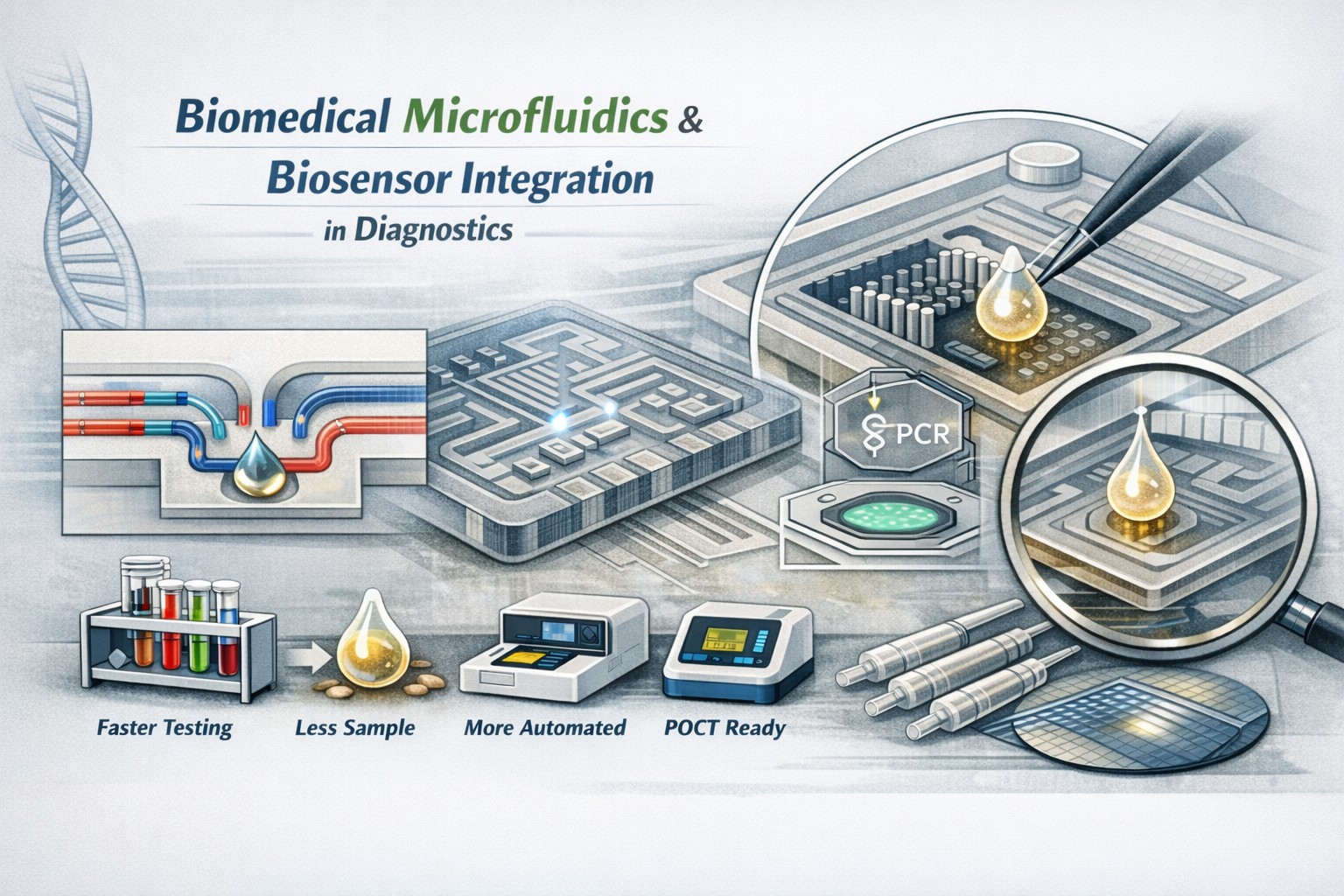
My research focuses on integrating biomedical microfluidics and semiconductor / micro–nano fabrication into medical laboratory workflows, with the goal of developing clinically relevant in vitro diagnostic (IVD) and portable diagnostic systems. For students with a background in Medical Laboratory Science, the workflows you already know—sampling, pretreatment, reactions, readout, and quality control—are not “separate” from engineering. In my lab, that diagnostic mindset becomes a key advantage to build testing systems that are faster, more automated, require less sample, and are closer to real point-of-care (POCT) use.
We start from clinical needs and laboratory bottlenecks, then redesign diagnostic steps—sample pretreatment, separation/enrichment, reaction, and detection—within microfluidic systems, while leveraging semiconductor and micro/nanofabrication to improve analytical performance and reproducibility. Topics may include integrated nucleic-acid and immunoassay testing, modular sample handling, biosensing and signal readout, and system-level validation with translational considerations. The emphasis is not only on making a device component, but on building a full pipeline from diagnostic needs → system design → fabrication & integration → performance validation, so outcomes can more naturally translate into real medical diagnostic devices and IVD products.
Skills you will gain (highly valuable for MLS students)
- Microchannel & microfluidic design and testing: workflow planning, chip testing, and optimization (miniaturizing and automating lab procedures)
- Micro/nano device & semiconductor-related fabrication: hands-on concepts and practice from design to fabrication (e.g., lithography/microfabrication and surface/film processes), and understanding how fabrication affects performance
- Engineering diagnostic problems: translating clinical requirements into specifications, and into measurable, interpretable, validated data
- A smoother bridge to diagnostic devices / IVD: system integration, robustness and interference evaluation, workflow feasibility, and product-oriented verification thinking
If you want training beyond running established protocols—and want to help create the next generation of diagnostic technologies with real clinical and industrial potential—this is an excellent direction to join.
In addition, students from Biomedical Engineering are also highly welcome. If your strengths include sensors, electronics/signal processing, mechanical design, materials and fabrication, or system integration, I am happy to collaborate in a co-advisor model with your primary supervisor to jointly develop a project. By combining clinical laboratory needs with biomedical engineering implementation, we aim to build more complete, translatable solutions for real-world diagnostic devices and IVD applications.
我的研究聚焦於生醫微流體與半導體/微奈米製程導入醫學檢驗流程,目標是發展能實際走向臨床與產業的體外診斷(IVD)與可攜式檢測系統。如果你是醫學檢驗相關背景,你一定熟悉採檢、前處理、加樣反應、讀值與品管等流程;我希望把這些「你熟悉的檢驗邏輯」變成研發優勢,讓檢驗可以更快、更省樣本、更自動化、也更貼近第一線使用情境(含 POCT)。
在本研究方向中,我們從臨床需求與檢驗痛點出發,將檢體前處理、分離濃縮、反應與偵測等步驟以微流體系統重新設計,並結合半導體與微奈米製程,提升檢測效能與可重現性。研究主題可涵蓋核酸與免疫檢測整合、樣本處理模組化、生物感測與訊號讀取,以及系統驗證與臨床可轉譯性評估——重點不只是做出元件,而是建立從「檢驗需求 → 系統設計 → 製作與整合 → 效能驗證」的完整研發鏈,讓成果更容易延伸為真正的醫療診斷設備與 IVD 產品。
你加入後可以學到的技能(醫檢系非常吃香)
微流道/微流體設計與測試:微流體操作原理、流程規劃、晶片測試與優化(把檢驗流程晶片化與自動化)
微奈米元件與半導體相關製程:從設計到製作的實作與概念(例如微影/蝕刻、薄膜與表面處理等),理解「製程如何影響檢測效能」
把檢驗問題工程化的能力:把臨床需求轉成規格,把規格轉成可量測、可判讀、可驗證的系統與數據
更好跨到醫療診斷設備/IVD 的路徑:系統整合、可靠度與干擾評估、流程可行性、以及貼近產品化思維的驗證方法
如果你希望自己的訓練不只停在既定檢驗流程,而是想站在「下一代檢驗技術」的起點,參與把檢驗變得更有效率、更可近、更可落地的研發工作——你會很適合加入。
此外,我也歡迎醫學工程背景的學生加入。若你的專長在感測器、電子/訊號處理、機構設計、材料與製程或系統整合,我很樂意以共同指導教授的方式,與你及你的指導老師共同規劃專題研究,結合醫檢的臨床需求與醫工的工程實作,打造更完整、可落地的醫療診斷設備與 IVD 解決方案。
榮譽獎項 Honors
- Xian-Qi Fang BioICT Ph.D Research Thesis Award — National Yang Ming Chiao Tung University (Oct 2025)
(方賢齊 BioICT 博士論文研究獎) - ScinoPharm Analytical Chemistry Thesis Award – Outstanding — Chemistry National Meeting, Taiwan Chemical Society (March 2025)
(台灣化學會年會—台灣神隆分析化學論文獎首獎) - Outstanding Graduate Award — College of Electrical Engineering, National Yang Ming Chiao Tung University (June 2024); Top 10% for research achievements
(電機學院優秀畢業生獎;研究表現前 10%) - Hon-Hai Technology Award — Digital Healthcare Group, Foxconn Education Foundation (December 2023); for acoustic microfluidic sputum liquefier technology for cancer cell detection
(鴻海科技獎—數位健康組;以聲學微流體痰液液化技術提升癌細胞檢測) - Hon-Hai – NYCU Joint Research Center Scholarship (2022–2024); consecutive awards for exceptional collaborative research
(鴻海–陽明交大聯合研究中心獎學金;連續獲獎)
研究發表 Publications
First-author publications
- Chang, C.-H.; Yu, Y.-H.; Lin, H.-P.; Tsou, P.-H.; Li, Y.-K.; Li, B.-R. (2024). A Wearable Exhaled Breath Condensate (EBC) Collector with Controllable Condensation Microfluidics and a Branched Hydrophilic Film. Chemical Engineering Journal, 499, 155994. (https://doi.org/10.1016/j.cej.2024.155994)
Author position: 1st (of 6) | Journal metrics: Q1; Rank 7/170 (Engineering, Chemical); IF 13.3
與新竹台大醫院合作:可穿戴 EBC 採集微流體,強化呼吸檢體收集。 - Chang, C.-H.; Lin, H.-P.; Chen, C.-W.; Lu, Y.-C.; Hsiao, F.-H.; Hsieh, C.-H.; Lin, B.-C.; Yu, B.-Y.; Ma, D.-L.; Kou, H.-C.; Tu, C.-C.; Li, B.-R. (2024). Au/SiC Microfluidic Devices Fabricated by Rapid Laser Cladding for Photocatalytic Degradation of Water Pollutants. ACS Sustainable Chemistry & Engineering, 12, 4486–4496. (https://doi.org/10.1021/acssuschemeng.3c07451)
Author position: 1st (of 12) | Journal metrics: Q1; Rank 21/170 (Engineering, Chemical); IF 7.1
與鴻海研究院、盛新材料、陽明交大國際半導體院杜長慶老師合作:雷射快速製程 Au–SiC 微流體,用於光催化降解。 - Chang, C.-H.; Nien, H.-H.; Li, B.-R. (2023). Development of a Vertical Bubble Acoustic Microfluidic Sputum Liquefier for Improved Cancer Cell Detection. Sensors and Actuators B: Chemical, 394, 134356. (https://doi.org/10.1016/j.snb.2023.134356)
Author position: 1st (of 3) | Journal metrics: Q1; Rank 1/76 (Instruments & Instrumentation); IF 8.0
與台北國泰醫院放腫科主任粘心華醫師合作:聲學微流體液化痰液,提升癌細胞檢出。 - Chang, C.-H.; Wang, C.-L.; Li, B.-R. (2023). Rapid Detection of Live Bacteria in Water Using Nylon Filter Membrane-Integrated Centrifugal Microfluidics. Biosensors and Bioelectronics, 236, 115403. (https://doi.org/10.1016/j.bios.2023.115403)
Author position: 1st (of 3) | Journal metrics: Q1; Rank 3/106 (Chemistry, Analytical); IF 10.7
定點、低檢測極限之濾膜+離心微流體,可做隨身型快速活菌檢測。
Co-authored publications
- Lee, B.-R.; Chiang, M.-F.; Ho, P.-Y.; Chen, K.-H.; Lee, J.-H.; Hsu, P.-H.; Peng, Y.-C.; Hou, J.-Y.; Chen, S.-C.; Lee, Q.-Y.; Chang, C.-H.; Li, B.-R.; Lin, T.-E.; Lin, C.-T.; Shih, M.-H.; Lien, D.-H.; Lin, Y.-C.; Horng, R.-H.; Kivshar, Y.; Tseng, M.-L. (2025). Deep-UV Silicon Polaritonic Metasurfaces for Enhancing Biomolecule Autofluorescence and Two-Dimensional Material Double-Resonance Raman Scattering. Advanced Functional Materials, 35(14), 2420439. (https://doi.org/10.1002/adfm.202420439)
Author position: 11th (of 20) | Journal metrics: Q1; Rank 10/231 (Chemistry, Multidisciplinary); IF 18.5
與陽明交大電子系曾銘綸老師合作:深紫外超表面增強螢光與拉曼訊號。 - Kuo, S.-H.; Peraro, A.; Lin, H.-P.; Chang, C.-H.; Li, B.-R. (2023). Hand-Powered Point-of-Care: Centrifugal Microfluidic Platform for Urine Routine Examination (μCUREX). Langmuir, 39, 1897–1904. (https://doi.org/10.1021/acs.langmuir.2c02923)
Author position: 4th (of 5) | Journal metrics: Q2; Rank 77/178 (Chemistry, Physical); IF 3.7
手搖式 POCT 平台:尿液常規檢驗。 - Lin, C.-F.; Chang, C.-H.; Noël, L.; Li, B.-R.; Meng, H.-F.; Soppera, O.; Zan, H.-W. (2023). NIR Laser Integration of Photodetector on 3D Printed Chamber for Colorimetric Biosensing. Advanced Materials Technologies, 8, 2201026. (https://doi.org/10.1002/admt.202201026)
Author position: 2nd (of 7) | Journal metrics: Q1; Rank 100/438 (Materials Science, Multidisciplinary); IF 6.4
與陽明交大光電系冉曉雯老師合作:3D 列印腔體整合偵測器做比色感測。 - Lin, C.-T.; Kou, S.-H.; Lin, P.-H.; Chiang, P.-H.; Lin, W.-H.; Chang, C.-H.; Tsou, P.-H.; Li, B.-R. (2020). Hand-Powered Centrifugal Microfluidic Disc with Magnetic Chitosan Bead-Based ELISA for Antibody Quantitation. Sensors and Actuators B: Chemical, 316, 128003. (https://doi.org/10.1016/j.snb.2020.128003)
Author position: 6th (of 8) | Journal metrics: Q1; Rank 1/76 (Instruments & Instrumentation); IF 8.0
手搖微流體盤整合 ELISA 做抗體定量。 - Chiu, P.-L.; Chang, C.-H.; Lin, Y.-L.; Tsou, P.-H.; Li, B.-R. (2019). Rapid and Safe Isolation of Human Peripheral Blood B and T Lymphocytes through Spiral Microfluidic Channels. Scientific Reports, 9(1), 8145. (https://doi.org/10.1038/s41598-019-44677-3)
Author position: 2nd (of 5) | Journal metrics: Q1; Rank 15/134 (Multidisciplinary Sciences); IF 3.8
螺旋微流道快速分離 B/T 淋巴球。
專利 Patents
學術譜系 Academic Genealogy
指導教授 國立陽明交通大學 智慧醫電工程研究所 李博仁 教授 https://liborran.weebly.com/
學術師公 國立陽明交通大學 應用化學系 李耀坤 教授 https://dac.nycu.edu.tw/portfolio-item/%E6%9D%8E%E8%80%80%E5%9D%A4-yaw-kuen-li/